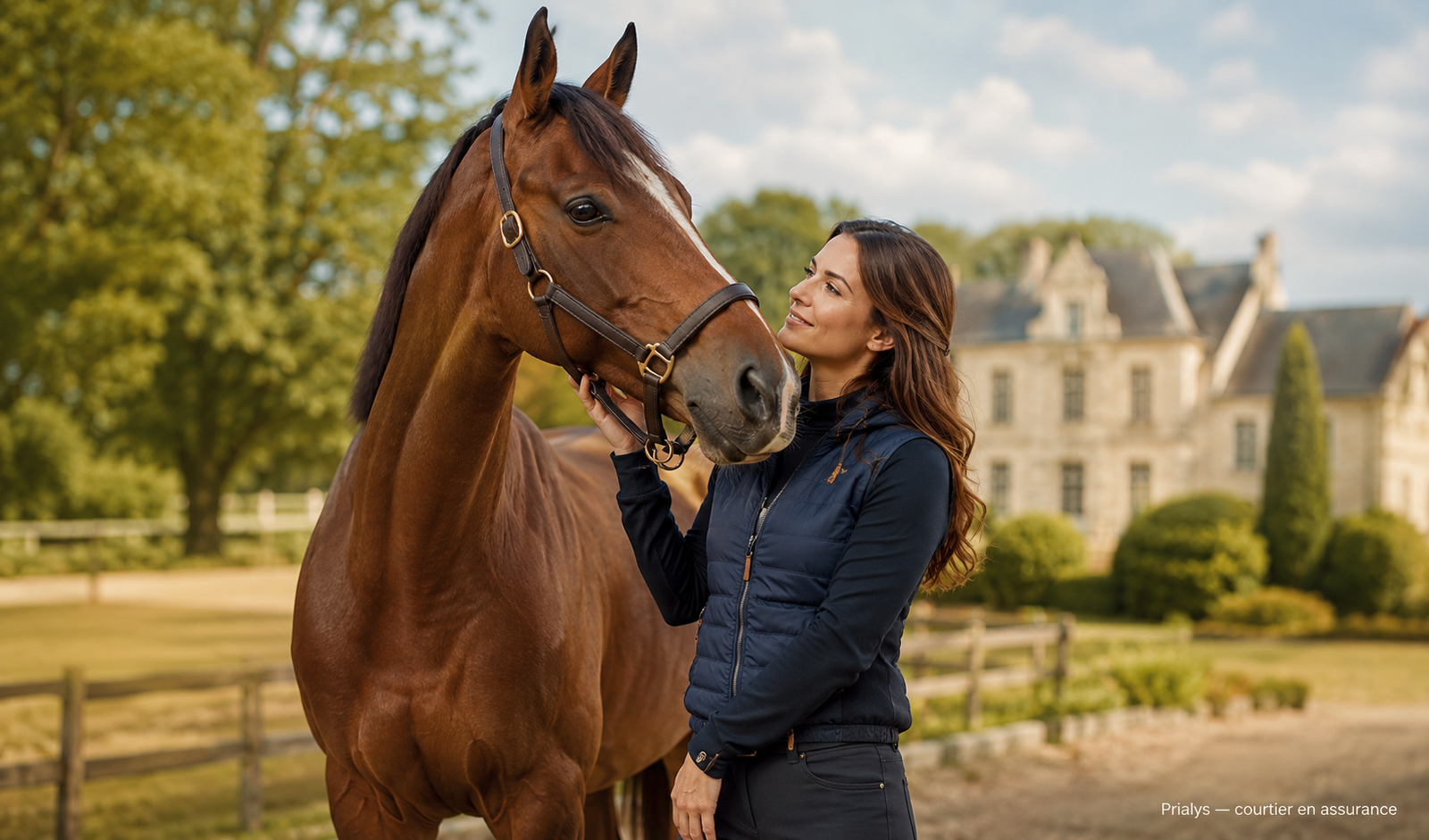
horse-insurance-prialys

Horse insurance — Equine cover does not work like dog and cat insurance : there is no entry / comfort / premium ladder. Cover is assembled item by item — owner’s civil liability, mortality, surgery, veterinary fees, permanent unfitness, theft — and priced individually on the value, age, use and keeping arrangements of the horse. Prialys, an independent broker, builds the combination that fits your situation, whether the horse is kept for leisure, sport or breeding.

  • Freedom of choice: Prialys, independent broker, freely compares market offers for your pet.
  • Savings: benefit from negotiated rates through our broker status and privileged partnerships.
  • Custom coverage: liability, mortality, surgery, veterinary fees, theft and transport, assembled to fit your horse.
  • Support: a dedicated contact for subscription, management and claims.

Horse Insurance coverage options

CoverWhat it protectsPoints to note
Owner’s civil liabilityDamage caused by your horse to a third party, whether or not you are presentThe foundation of any equine file. Often required by yards and by competition organisers
MortalityDeath of the horse through illness or accident, and euthanasia on veterinary groundsBased on an agreed value, supported by an invoice and a veterinary examination
SurgerySurgical procedures, colic surgery in particularUsually the first health cover taken out, because a single procedure is very costly
Veterinary feesConsultations, tests, imaging, treatment and follow-up careTaken as an extension to surgery cover, with its own annual limit
Permanent unfitnessDefinitive loss of the use for which the horse was acquiredAssessed by a vet. Frequently restricted or excluded for older horses
Theft and disappearanceTheft of the horse, and of tack depending on the policyRequires identification and proof of ownership
TransportIncidents occurring while the horse is being transportedSometimes an extension, sometimes a separate policy
Legal expensesDisputes over a sale, boarding arrangements or veterinary mattersOptional but useful given how often sales are contested
Professional coverRiding schools, livery yards, breeders and dealersA different framework altogether: professional liability and business cover

No percentages or limits are quoted here on purpose. Unlike the dog, cat and exotic pet market, equine cover is underwritten individually : the agreed value of the horse, its age, its use and where it is kept determine both the premium and the limits. Any figure shown as a market standard would be misleading.

Position of the French equine insurance market verified in August 2026. This page is for information only and is not a contractual commitment : only the general terms and conditions of the policy apply.

How does horse insurance work?

1. Profile – Value, age, use

2. Cover – Liability, mortality, surgery

3. Quote – Several underwriters approached

4. Subscription – Electronic signature

5. Review – Annual update of the agreed value

  • Needs analysis: value, age, use of the horse and where it is kept.
  • Review of what you already have: we check what your home policy and your federation licence already cover.
  • Market approach: we canvass our partner underwriters and the specialist equine market.
  • Subscription and follow-up: electronic signature, certificate, then an annual review of the agreed value.

Questions? Call us today!

09 52 92 25 30

Brochures

Need detailed information on our equine and pet insurance solutions ? The Prialys team, an independent broker, is available to review your situation and your current policies with you.

What documents to subscribe to your horse insurance?

  • Proof of identity and contact details of the owner.
  • Equine passport, SIRE number and transponder number.
  • Purchase invoice or valuation, plus the competition record where relevant.
  • Declaration of the place where the horse is kept, and the livery or boarding agreement.
  • Recent veterinary examination and the claims history statement from your previous insurer.

Frequently asked questions about horse insurance

ItemDetails
Civil liabilityDamage caused by the horse to a third party, in the stable, at grass, in transport or in competition.
MortalityDeath through illness or accident, and euthanasia on veterinary grounds, against the agreed value.
SurgerySurgical procedures, colic surgery above all, with anaesthesia and hospitalisation.
Veterinary feesConsultations, tests, imaging, treatment and follow-up, within the limit set in the policy.
Permanent unfitnessDefinitive loss of the intended use, after veterinary assessment.
TheftTheft or disappearance of the horse, and of tack depending on the policy.
ItemDetails
Agreed valueSet too low it undermines the settlement, set too high it inflates the premium. Review it every year.
Age limitsThey differ by cover and by underwriter, and mortality closes earlier than veterinary fees.
Pre-existing conditionsAnything already present, and often anything affecting a limb previously treated, is excluded.
Use declaredLeisure, sport, breeding or professional use: a change of use must be declared or cover can fail.
Waiting periodsThey apply to illness and to surgery, and are longer than on dog and cat policies.
Overlap with other coverYour federation licence and your home policy may already provide some liability cover. Check before duplicating.
Professional activityTeaching, boarding or dealing takes the file out of the private framework entirely.

Documents for your horse insurance

Is horse insurance compulsory in France?

There is no general legal obligation to insure a horse. In practice, however, owner’s civil liability is close to indispensable, and livery yards, riding centres and competition organisers commonly require proof of it. Riders holding a federation licence usually have some liability cover through the licence itself, but its scope is limited and worth checking.

Does my home insurance cover my horse?

Rarely, and never fully. Most home policies exclude or heavily limit damage caused by an equine, especially when the horse is kept away from the property. Reading the general terms and conditions before relying on it is essential.

What is an agreed value?

The value of the horse fixed with the insurer when the policy is written, on the basis of the purchase invoice, the pedigree and the competition record. Mortality, theft and permanent unfitness claims are settled against that figure.

Is colic surgery covered?

Yes, under surgery cover, subject to the waiting period and the limits set out in the policy. It is the single most frequent reason for taking out equine health cover.

Up to what age can a horse be insured?

Each underwriter sets its own limits, and they differ by cover : mortality and permanent unfitness usually close earlier than veterinary fee cover. We check them case by case rather than quote a market age, because there is no single standard.

What identification is required?

In France a horse must have its SIRE number, its transponder and its equine passport, and the place where it is kept must be declared. Without that identification, no claim can be settled.

Parlons-en

Talk to our broker

Adresse email : contact@prialys.fr
Téléphone : 09 52 92 25 30
Address: Miniparc 3 478, Rue de la Découverte CES 67624, 31670 Labège

    FAQ – Horse Insurance

    Where to start?

    With civil liability. A horse is a large animal that can injure someone or damage property even when you are not there, and the owner is answerable for it. Yards and competition organisers routinely ask for proof of cover. Health cover comes next, and surgery is usually the priority because a single colic operation can outweigh several years of premiums.

    Why the agreed value matters

    Mortality, theft and permanent unfitness are all settled against an agreed value fixed when the policy is written. Set it too low and the settlement will disappoint ; set it too high and you pay for cover you cannot claim. It should be supported by the purchase invoice and reviewed each year, particularly for a competition horse.